Residential License # 890459
Commercial License # 3667
Designing the Great Outdoors. - New Orleans's #1 Outdoor Design Company!



Talk to an Expert
Residential License # 890459
Commercial License # 3667
Talk to an Expert

Fixing backyard drainage in New Orleans starts with finding where the water goes, not where it sits. The usual causes are a yard that slopes the wrong way, compacted soil, and hard surfaces sending runoff into one low spot. The fixes are regrading, a French drain or swale to carry water to an outlet, and permeable surfaces that let rain soak in rather than run off.
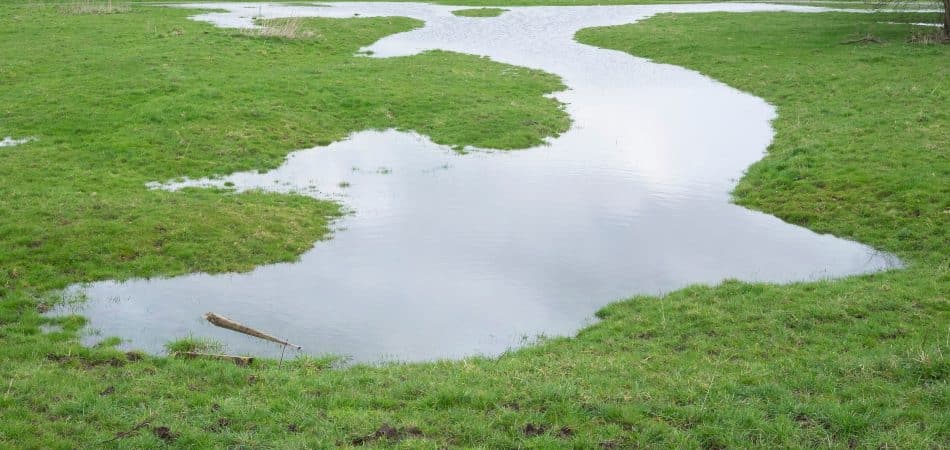
A yard that holds water after every storm is not a patience problem. Water still sitting a day later is telling you it has nowhere to go.
The good news is that backyard drainage is one of the more solvable outdoor problems, once the cause is identified rather than guessed. At TurnKey Outdoor Designs, we work on yards across the New Orleans area where water has to be dealt with before anything gets built.
Here is why yards hold water locally, which signs mean act now, and how the fixes actually work. Contact us today to have a wet yard looked at before the next heavy rain.
Three things stack up locally, and most wet yards have at least two. The first is elevation, because a flat lot with nowhere lower to send water holds whatever falls on it.
The second is soil. Heavy clay drains slowly on its own, and foot traffic, parked vehicles, or construction compact it further, closing the pore space water would otherwise move through.
The third is what got added on top. Patios, driveways, walkways, and roof runoff concentrate water that used to spread out, and with no path to follow it settles at the lowest point.
Some pooling is cosmetic and some means water is working where it should not be. That difference decides whether you watch it or act.
| What You Notice | What to Do Next |
|---|---|
| A puddle that clears within a day of the rain stopping | Note where it forms and watch it through a few more storms. |
| Water still standing more than a day after the rain | The yard has no outlet. Get the grade and soil assessed. |
| Ground stays spongy underfoot even in a dry week | Look for a leak, an irrigation fault, or a high water table. |
| Water pooling against the house or under a raised floor | Treat this as priority and have the perimeter grade assessed. |
| Mulch, soil, or gravel washing across a path after storms | Concentrated flow is running somewhere. Trace the path uphill. |
| Water crossing onto or in from a neighboring property | Get it assessed before changing anything, since the fix affects both lots. |
Watch it rain. Nothing tells you more than seeing where water enters, crosses, and stops during a storm.
Work through this in order:
That last one has a published benchmark. The International Residential Code calls for the grade to fall at least 6 inches within the first 10 feet from the foundation walls, and for impervious surfaces within 10 feet to slope at least 2 percent away.
Treat those as a target rather than a local guarantee, since code adoption varies by jurisdiction. Confirm what applies at your address with the local building authority.
Every drainage fix does one of two things: it changes where water goes, or it gives water somewhere to soak in. Four approaches cover almost every yard.
Regrading reshapes the ground so water runs where you want it instead of where it goes now. It is the first option worth considering, because it fixes the cause rather than the symptom.
A swale is a shallow, planted channel that carries water along a deliberate route. It looks like part of the landscape rather than a drainage feature, which is why it suits front and side yards.
The code language covers the case where regrading alone cannot work. Where lot lines, walls, slopes, or other physical barriers prohibit the required fall, drains or swales have to be built instead to carry water away from the structure.
A French drain is a perforated pipe in a gravel-filled trench, wrapped in filter fabric. Water enters through the gravel, gets into the pipe, and travels to an outlet.
The outlet is the part that decides whether it works. A French drain that ends nowhere just moves the puddle underground, so the run has to fall consistently toward somewhere the water can actually leave.
Filter fabric matters more than people expect. Without it, fine soil migrates into the gravel and the drain silts up over the years until it stops moving anything.
A catch basin is a box set into a low point with a grate on top, connected to a pipe. It takes surface water fast, which suits spots where water arrives quicker than the soil absorbs it.
Basins pair well with hard surfaces, since a patio or drive delivers a lot of water fast. Our patio installation work sets fall and drainage at the same time as the surface, because retrofitting under a finished patio is a far bigger job.
Basins need clearing. Leaves and silt collect on the grate and in the sump, and a blocked basin is functionally a low spot with a lid on it.
A permeable surface lets rain pass through into a prepared base rather than shedding it sideways. Less runoff leaving the surface means less water arriving at the low point.
This works best as part of the overall plan rather than as the whole fix. It reduces how much water the drainage has to handle, which is different from handling it.
The base build is what makes it function. An open-graded stone base with room to hold water while it soaks away does the real work, and the surface above is the visible part.
Drainage work usually goes wrong for reasons unrelated to the digging. Settle these first.
That last point saves the most money. Our outdoor deck builds are laid out with the drainage route already fixed, because a drain running under a finished structure is a problem you solve once.
Backyard drainage is a solvable problem, and the sequence never changes: find where the water comes from, decide where it should go, then pick the method that gets it there. Guessing at the method first is how people end up with a drain that moves nothing.
At TurnKey Outdoor Designs, we walk the yard during or right after rain when we can, because that is when the water shows you the answer. Call us today to get your drainage assessed before you plan anything else outdoors.
Surface water should generally be gone within about a day of the rain stopping. Water still standing beyond that points to a yard with no outlet, soil too compacted to absorb it, or a high water table underneath. Any of those is worth assessing rather than waiting out.
Fixing a yard that holds water starts with identifying where water enters and where it collects, then choosing between regrading so it runs off, a French drain or swale to carry it to an outlet, and permeable surfaces that reduce runoff at the source. Most yards need a combination rather than one fix.
Cost depends on the length of the run, the depth, soil conditions, how far the outlet sits, and what has to be dug around or restored afterward. A short run to a nearby outlet is a very different job from a long run across a finished landscape. Ask for a site-specific quote.
Regrading addresses the cause and is usually the first option worth pricing, since water that never collects needs no drain. It stops being an option when lot lines, walls, or existing slopes make the required fall impossible, which is exactly when a drain or swale takes over.
That depends on local rules, which vary on discharge points, street connections, and water crossing onto a neighboring property. Do not assume a route is acceptable because it runs downhill. Confirm the permitted outlet with the local authority before the system is designed around it.
A permeable surface reduces how much water runs off into the yard, because rain passes through into a prepared stone base and soaks away instead. It lightens the load on the rest of the drainage rather than replacing it, and the base build underneath is what makes it work.
A single persistent wet spot usually means a local low point, a compacted layer under the surface, or a leak from an irrigation line or service pipe. If the patch stays spongy through a dry stretch with no rain to explain it, a leak moves to the top of the list.
Water pooling against the house is worth treating as a priority rather than a cosmetic issue, which is why the code sets a target fall away from foundation walls. Whether it has affected a specific foundation is a question for a qualified assessment, not something to judge from the surface.
 Turnkey Outdoor Designs